What Is Actually Recorded
Every ancient castle carries its stories. This page shows only what is attested by primary or standard sources. Romantic embellishments without documentary basis are deliberately omitted.
King Laurin & the Rose Garden
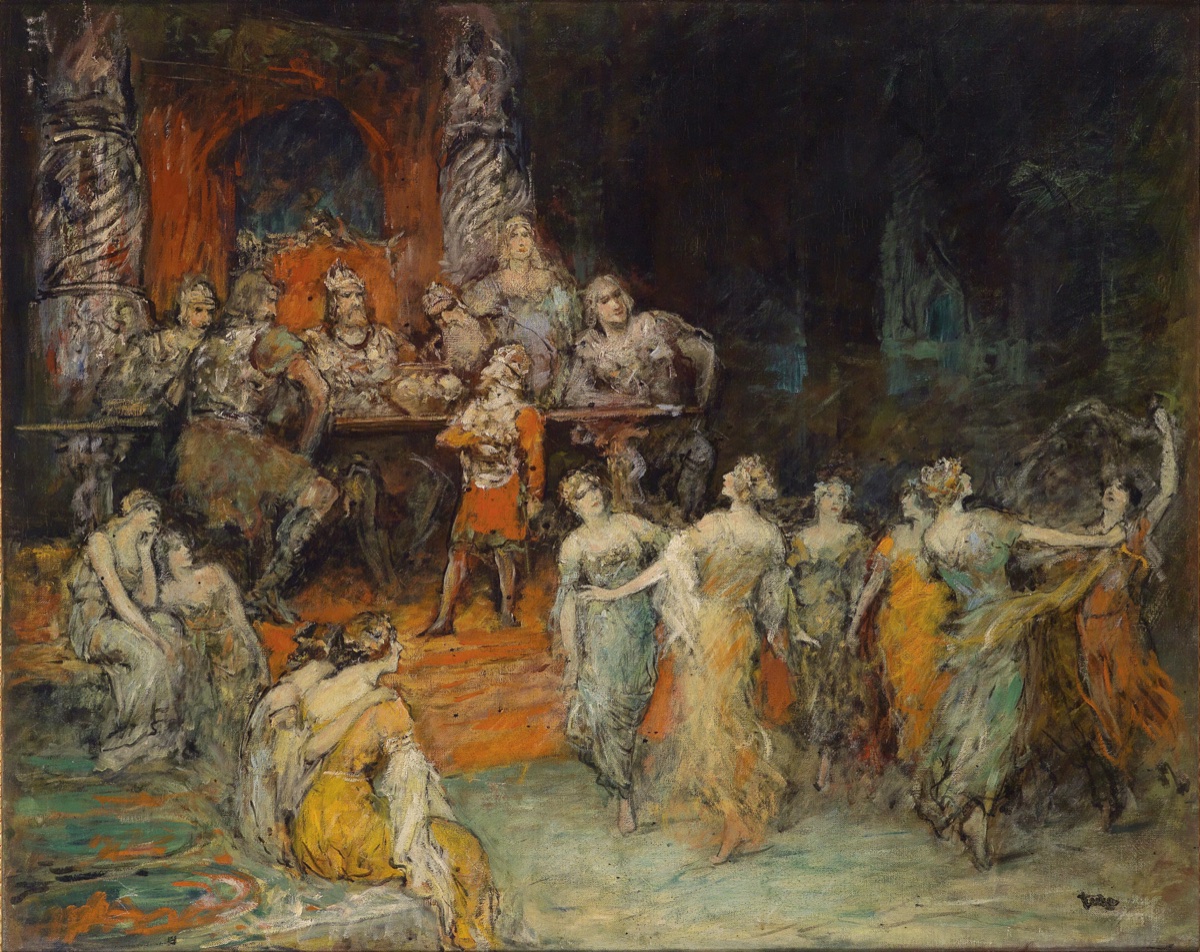
Dwarf King Laurin at the court of Dietrich von Bern — Ferdinand Leeke (before 1923, oil on canvas, Public Domain)
Deep in the Dolomites, high above the Vinschgau valley, there once ruled the mighty dwarf king Laurin. In his underground palace he hoarded countless treasures — but his greatest pride was his rose garden, which filled the mountains with the scent of thousands of red roses.
Anyone who picked even a single rose was punished: with the loss of his right hand and left foot.
When the hero Dietrich von Bern and his retinue approached, battle broke out. Laurin had a cloak of invisibility and a belt that gave him the strength of twelve men — but Dietrich's cunning overcame even this magic, and Laurin was captured.
In anger, Laurin cursed his garden so that it should be seen neither by day nor by night — but he forgot the evening glow. And so the Dolomites glow red every evening: Laurin's eternally burning rose garden.
The Wayside Cross of Lichtenberg (1799)
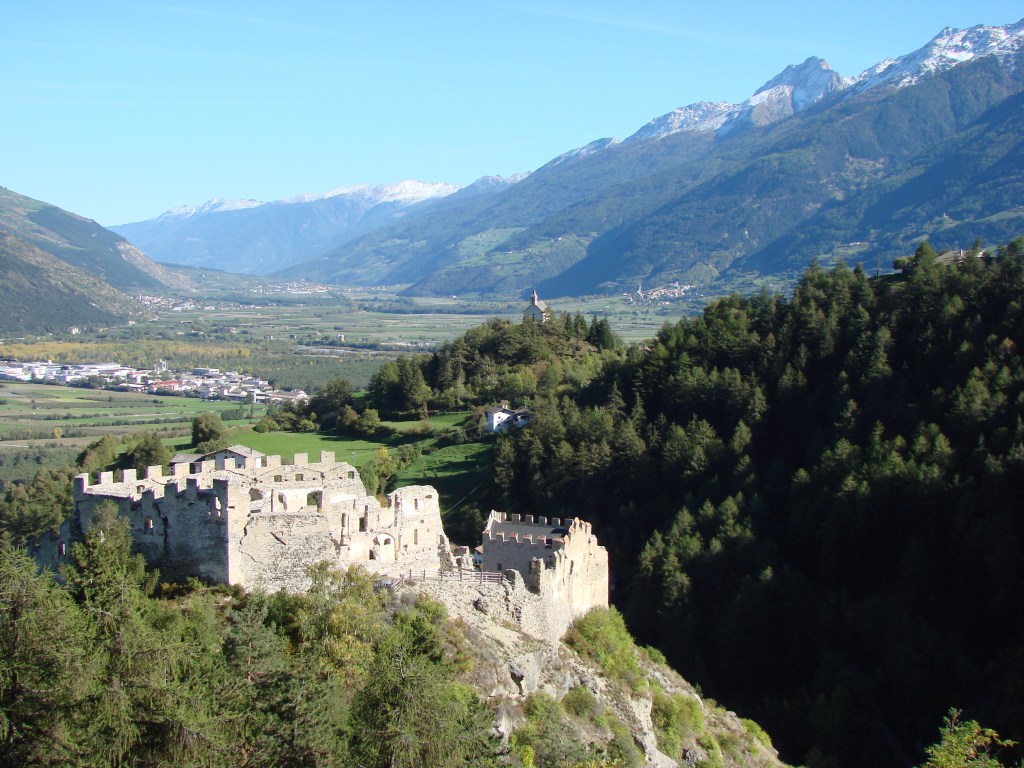
View of the ruins of Lichtenberg Castle with the St. Christina Chapel (built 1575) — Flyout / Wikimedia Commons / CC BY-SA 3.0
In the turmoil of 1799, when French troops were marching through the Vinschgau, an event unfolded on the slopes below Schloss Lichtenberg that long remained in local memory.
A simple farmer refused to hand over his last grain. As a warning, soldiers knocked down a wooden wayside cross — a sign of faith that had stood there for generations.
But that very night the farmer saw a strange light at the spot. The next morning the cross stood upright again — as if it had raised itself.
A new cross was erected and stands at that spot to this day — a sign that faith is stronger than any violence.
Laurin in Culture
The Laurin legend did not remain confined to the pages of medieval manuscripts. It lives with extraordinary tangibility in the Dolomite landscape of South Tyrol, where the mountain itself bears the name of the legendary dwarf king.
The Catinaccio — known in German as Rosengarten (Rose Garden) and in Ladin as Ciampedìe — is the Dolomite massif that turns a blazing red every evening at sunset. According to legend, this phenomenon is nothing other than Laurin's curse: the rose garden he condemned to be seen neither by day nor by night, but forgot to exclude from the evening glow. The term Enrosadüra (Ladin: «to turn rosy») describes this natural spectacle, which still draws thousands of visitors today.
The König-Laurin-Wand — the north-western face of the Catinaccio — bears the dwarf king's name directly. In the centre of Bolzano, a monumental fountain (by Herbert Ortner) celebrates the myth.
The frescoes of Schloss Lichtenberg, dating from around 1350–1400, are the oldest and most extraordinary visual testimony of this legendary cycle in the Alps: a direct bridge between the Middle High German poem Laurin (ca. 1200, anonymous) and the pictorial culture of the 14th-century Tyrolean aristocracy.
Discover More
After free registration, more documented legends and research reports are available.
Ghost of the Last Lord
The Silver Treasure Legend
Free registration – no subscription needed for basic content.
Stay Informed
Opening times, events and new content – directly to your inbox.